
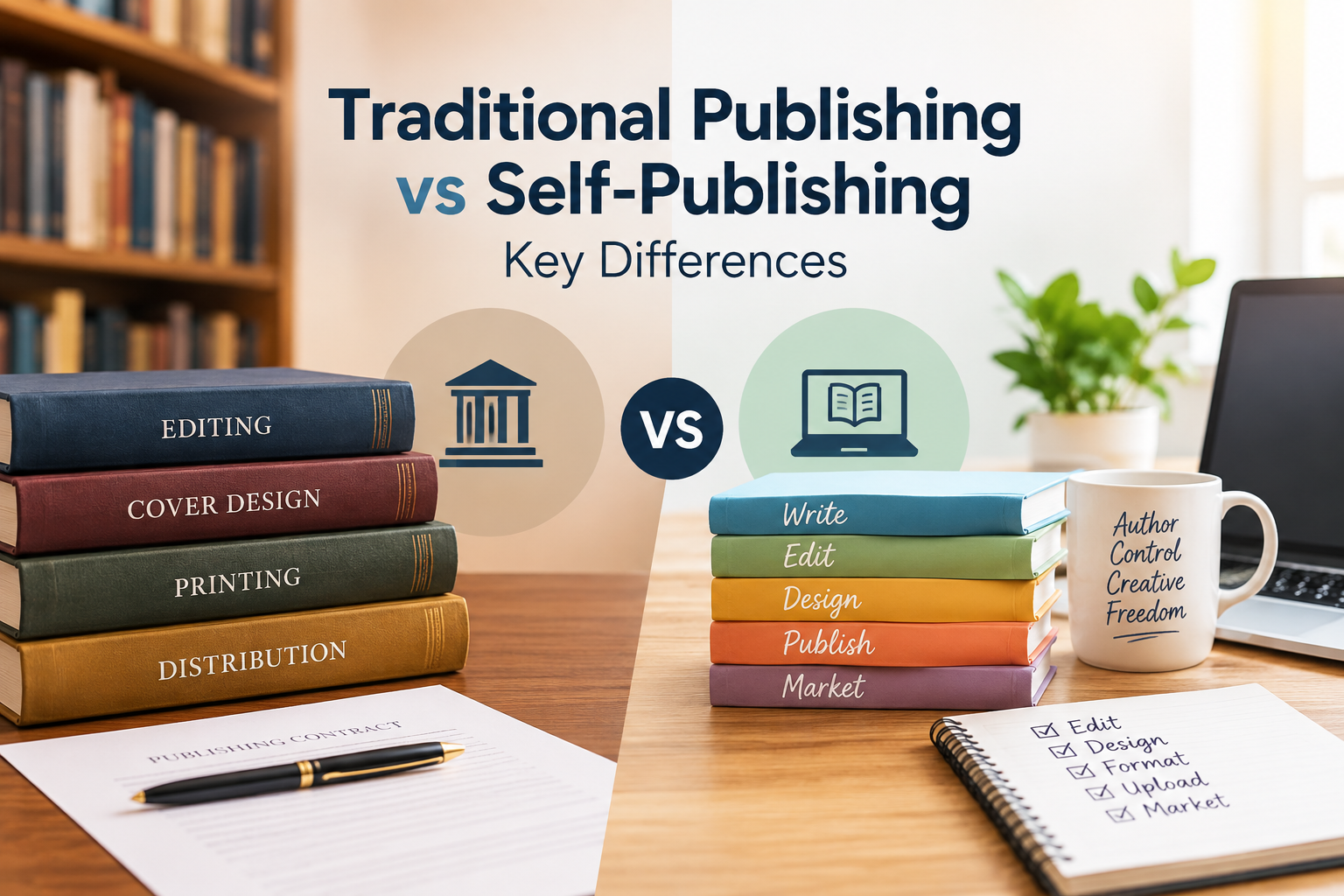
Finishing a manuscript is only one part of becoming a published author. The next major decision is determining how to publish a book. For most authors, that means choosing between traditional publishing and self-publishing.
The difference between traditional publishing vs self-publishing goes beyond simply deciding who uploads a book to Amazon. The two publishing models differ in how books are acquired, financed, edited, designed, distributed, marketed, and sold. They also differ in the amount of creative control an author has, the time it takes to publish, and how the author is compensated.
Traditional publishing generally involves working with a publishing house, often after securing a literary agent. The publisher typically finances the production of the book and pays the author an advance against future royalties. Self-publishing puts the author in control of the publishing process, allowing them to hire professionals or manage services such as editing, book cover design, formatting, distribution, and marketing independently.
Neither model works exactly the same for every author. The right choice depends on the author's goals, budget, timeline, genre, desired level of control, and distribution priorities.
Traditional Publishing vs Self-Publishing at a Glance
FactorTraditional PublishingSelf-PublishingPublisherEstablished publishing houseAuthor or author-controlled publishing operationAcquisitionUsually through a literary agent or direct submission to eligible publishersAuthor decides when and where to publishUpfront production costsGenerally paid by the publisherGenerally paid by the authorEditingPublisher's editorial team and/or contracted professionalsAuthor hires or manages editorsCover designPublisher generally controls the processAuthor controls the design or hires a designerFormattingPublisher handles productionAuthor or hired professionals handle formattingCreative controlShared with publisher; contract terms applyPrimarily retained by the authorAdvanceCommon in many traditional contracts, but not universalNo traditional publishing advanceRoyaltiesContract-specific and generally lower per copy than self-publishingCan be higher per copy, depending on platform, format, price, and costsPublishing timelineOften longerCan be considerably fasterDistributionStrong access to established distribution networksPrimarily author-managed through selected platforms and distributorsBookstore accessPublisher may have established trade distribution and sales relationshipsAvailable through distributors, but physical placement often requires additional effortMarketingPublisher may provide marketing support, but author participation is often importantAuthor is responsible for or hires marketing supportControlLimited compared with self-publishingHigh
The important point is that traditional publishing transfers more of the production and publishing responsibility to a publisher, while self-publishing transfers more responsibility and control to the author.
What Is Traditional Publishing?
Traditional publishing is a model in which an established publishing company acquires the rights to publish an author's work. The publisher then manages or commissions many of the professional services required to turn the manuscript into a finished book and distribute it to readers.
For many commercial genres, authors seeking traditional publication first approach literary agents. An agent may then submit the manuscript or book proposal to publishing houses on the author's behalf.
If a publisher acquires the book, the author typically enters into a publishing agreement that establishes matters such as rights, royalties, advances, publication obligations, and other contractual terms.
How the Traditional Publishing Process Works
Although individual publishers and genres have different processes, a typical path can look like this:
- The author completes and prepares the manuscript.
- The author researches literary agents who represent the appropriate genre.
- The author submits a query letter and requested materials to agents.
- An agent may offer representation.
- The agent submits the project to publishers.
- A publisher evaluates the project and may offer a publishing contract.
- The publisher acquires agreed publishing rights.
- The manuscript goes through editorial development.
- The publisher manages or commissions cover design and book production.
- The finished book enters the publisher's distribution and sales network.
- The book is released through the publisher's selected channels.
This process can take substantially longer than independently publishing a finished manuscript because acquisition, contracting, editorial work, production, scheduling, printing, and distribution all have to be coordinated.
Who Pays for Traditional Publishing?
One of the major differences between traditional publishing vs self-publishing is who finances the production of the book.
In a conventional traditional publishing arrangement, the publisher generally pays for professional production expenses such as editing, cover design, typesetting or formatting, printing, and distribution. The author does not normally receive an invoice for these standard production services.
The author may also receive an advance against royalties. An advance is money paid to the author before royalties from book sales have fully recouped that advance. According to the Authors Guild, advances can vary considerably, and some small, independent, and academic presses do not pay advances. Royalties generally begin being paid after the publisher has recouped the advance according to the terms of the contract.
The exact financial arrangement depends on the publishing agreement, so authors should carefully review the contract rather than assuming that every traditional publisher offers the same terms.
How Much Do Traditional Publishers Pay in Royalties?
Traditional publishing royalties are contract-specific. The percentage can depend on the format of the book, the publisher, the sales channel, and the negotiated agreement.
This is one reason it is misleading to compare a traditional royalty percentage directly with a self-publishing platform's headline royalty percentage. The calculation method, production costs, distribution arrangements, rights, and contractual definitions can be different.
Authors represented by literary agents should also account for agent commissions when evaluating their potential earnings. The Authors Guild states that a 15% commission on domestic book publishing agreements is generally standard for literary agents.
What Is Self-Publishing?
Self-publishing is a publishing model in which the author retains responsibility for bringing the book to market instead of transferring publishing rights and production responsibility to a traditional publishing house.
That does not necessarily mean the author personally performs every task.
A self-published author can hire professional editors, book designers, formatters, illustrators, marketers, publicists, or other specialists. The author remains responsible for deciding which services to use and how the book will ultimately be published.
Popular self-publishing platforms include Amazon Kindle Direct Publishing (KDP), along with other digital and print distribution services.
How the Self-Publishing Process Works
A typical self-publishing workflow may include:
- Complete the manuscript.
- Have the manuscript professionally edited.
- Proofread the final text.
- Develop a professional book cover.
- Format the manuscript for ebook and print editions.
- Prepare metadata, including the title, subtitle, description, categories, and keywords.
- Select publishing and distribution platforms.
- Upload the manuscript and cover.
- Set the book's pricing and distribution options.
- Order or review a proof copy where appropriate.
- Publish the book.
- Promote the book through marketing, advertising, author branding, publicity, social media, email marketing, or other channels.
The author therefore has considerably more responsibility for the publishing operation.
How Much Does Self-Publishing Cost?
Unlike traditional publishing, self-publishing generally requires the author to finance the services needed to produce and promote the book.
The actual cost can vary significantly.
A professionally produced book may require some combination of:
- Developmental editing
- Copyediting
- Proofreading
- Book cover design
- Interior formatting
- Ebook formatting
- Illustration
- Audiobook production
- ISBNs, depending on the publishing strategy and country
- Marketing
- Advertising
- Public relations
- Author website development
- Distribution services
There is no single universal self-publishing cost because authors can choose which services to purchase, which platforms to use, and how much work to perform themselves.
Print-on-demand platforms can also reduce the need for an author to purchase a large inventory of books in advance.
For example, Amazon KDP states that it prints paperback and hardcover books on demand, meaning authors do not have to purchase or store inventory upfront for those orders.
This distinction is important: self-publishing does not necessarily require a large printing investment, but producing and marketing a professional book can still involve meaningful costs.
Self-Publishing Royalties vs Traditional Publishing Royalties
Royalties are frequently mentioned when comparing traditional publishing vs self-publishing, but percentage figures should always be considered in context.
With self-publishing, the author generally receives a larger percentage of the sale under many platform programs, but that percentage does not mean the author keeps the entire selling price.
For example, Amazon KDP currently offers two ebook royalty options: 35% and 70%. The 70% option is subject to eligibility requirements, territories, pricing rules, and delivery-cost deductions.
For print books, KDP currently offers a 50% or 60% royalty rate for standard distribution depending on the marketplace and list price, with printing costs deducted from the royalty calculation. Expanded Distribution uses a different royalty calculation.
So, for example, a 60% print royalty does not mean an author receives 60% of the retail price as pure profit. KDP's calculation subtracts applicable printing costs.
This is why authors should compare net earnings per sale, not simply the advertised royalty percentage.
Creative Control: Traditional Publishing vs Self-Publishing
Creative control is one of the most significant differences between the two models.
Creative Control in Traditional Publishing
A traditional publisher invests money and resources into producing and selling the book. As a result, the publisher generally has a significant role in decisions involving the manuscript, title, cover, positioning, production, and marketing.
The precise level of author involvement depends on the publisher, the contract, the author, and the project.
Authors may work closely with editors and other members of the publishing team, but they should not assume they will have complete control over every publishing decision.
Creative Control in Self-Publishing
Self-publishing gives the author substantially more control over the publishing process.
The author can generally decide:
- When to publish
- What title to use
- How the cover should look
- Which editor to hire
- How the book is formatted
- What price to set
- Which platforms to use
- Which distribution options to select
- How the book is positioned
- How and when marketing campaigns are run
The trade-off is that greater control comes with greater responsibility.
If the author makes poor production, metadata, pricing, distribution, or marketing decisions, there is no traditional publishing team automatically responsible for correcting those decisions.
Traditional Publishing vs Self-Publishing: Timeline
The publishing timeline can also be very different.
Traditional publishing frequently involves a longer sequence of acquisition, contracting, editorial development, production, scheduling, printing, and distribution. A manuscript may therefore take a significant amount of time to reach readers after a publisher accepts it.
Self-publishing can move much faster because the author controls the publishing schedule.
Once editing, design, formatting, metadata, and other preparations are complete, an author can upload the book to a publishing platform and proceed through its review and publication process.
This does not mean every self-published book can be professionally produced in a few days. High-quality editing, cover design, formatting, proofreading, and marketing preparation still take time.
The distinction is that self-publishing removes the publisher's acquisition and production schedule from the process.
Bookstore Distribution: Traditional Publishing vs Self-Publishing
Bookstore distribution is another area where authors often misunderstand the difference.
Traditional publishers generally have established relationships with distributors, wholesalers, retailers, sales representatives, and other parts of the book trade. This can make access to physical bookstores more structured.
Self-published books can also be distributed through services that make them available to bookstores and libraries.
For example, Amazon KDP offers Expanded Distribution for eligible paperbacks, allowing books to become available to distributors through which bookstores and libraries can order them.
However, being available for order is not the same as being physically stocked on bookstore shelves.
A self-published author may still need to create demand, establish relationships, work with appropriate distributors, arrange events, pursue publicity, and demonstrate that there is a reason for a retailer to dedicate physical shelf space to the book.
For authors whose primary goal is broad physical bookstore distribution, this distinction deserves careful consideration.
Marketing: Who Promotes the Book?
Another common misconception is that traditional publishing means the publisher handles all marketing while self-publishing means the author does everything alone.
The reality is more nuanced.
Traditional publishers may provide marketing and publicity support, but the level of support varies based on the publisher, book, market, author, and publishing strategy. Authors are often expected to participate in building awareness for their books.
With self-publishing, the author has primary responsibility for marketing unless they hire outside professionals.
Self-published authors can use:
- Amazon advertising
- Social media marketing
- Email marketing
- Author websites
- Search engine optimization
- Book publicity
- Digital PR
- Podcast appearances
- Reader communities
- Book reviews
- Events and speaking opportunities
- Promotional campaigns
Marketing therefore becomes an important part of the author's business responsibilities when choosing self-publishing.
Pros and Cons of Traditional Publishing
Understanding the advantages and disadvantages of traditional publishing can help authors determine whether the model aligns with their goals.
Potential Advantages of Traditional Publishing
Publisher-Funded Production
The publisher generally covers standard production expenses under the publishing agreement, including editorial and production work.
Professional Publishing Team
Authors can work with editors, designers, production specialists, sales teams, and other publishing professionals.
Established Distribution
Traditional publishers can have established relationships with distributors and retailers, which can provide access to parts of the physical book market that may be difficult for an individual author to reach independently.
Advance Against Royalties
Many traditional publishing contracts include an advance, although advances are not universal and vary considerably.
Industry Infrastructure
A traditional publisher can provide an established infrastructure for production, distribution, sales, rights management, and other publishing activities.
Potential Disadvantages of Traditional Publishing
Longer Timeline
The acquisition and production process can take considerably longer than independent publication.
Less Creative Control
The publisher generally has a meaningful role in editorial, design, positioning, and other publishing decisions.
Competitive Acquisition Process
Authors may need to secure literary representation and persuade a publisher to acquire the project.
Lower Per-Copy Royalty Percentage
The author generally receives a smaller share of the book's economics than they might receive through some self-publishing platforms, although the comparison depends on the entire financial arrangement.
Contractual Rights
Authors transfer or license specific rights to the publisher according to the publishing contract. Understanding those rights is essential before signing.
Pros and Cons of Self-Publishing
Potential Advantages of Self-Publishing
Greater Creative Control
The author retains substantially more control over the book's content, design, pricing, positioning, and publication schedule.
Faster Publication
Authors can publish once the book is professionally prepared and the selected platform's requirements have been met.
Higher Platform Royalty Rates
Depending on the platform, format, territory, and pricing, self-published authors may receive a substantially higher percentage of each sale.
For example, KDP currently offers up to 70% ebook royalties under its qualifying 70% royalty option and up to 60% for eligible standard print sales before applicable deductions such as delivery or printing costs.
Direct Control Over Pricing
Authors can set and adjust pricing according to the rules of their chosen platforms.
Direct Access to Readers
Self-published books can be made available through major online marketplaces without waiting for a traditional publisher to acquire the project.
Potential Disadvantages of Self-Publishing
Upfront Responsibility
The author is responsible for arranging and financing professional services.
Marketing Responsibility
Without a traditional publisher's infrastructure, the author must manage marketing personally or hire specialists.
Quality Control Is the Author's Responsibility
Professional editing, proofreading, cover design, and formatting are important because there is no traditional publishing team automatically managing those stages.
Physical Bookstore Placement Can Be More Difficult
Online availability does not automatically translate into physical shelf space.
Business Management
Self-publishing requires authors to make decisions about pricing, distribution, metadata, marketing, advertising, rights, production, and sales.
Is Traditional Publishing Worth It?
Whether traditional publishing is worthwhile depends on what an author wants from the publishing process.
For an author who prioritizes publisher-supported production, established industry infrastructure, traditional distribution, and an advance, the traditional model may align with those objectives.
For an author who prioritizes creative control, speed, direct publishing decisions, and potentially higher per-sale royalties, self-publishing may better match those objectives.
There is no universal answer because the economics and practical benefits can change significantly from one author and book to another.
The more useful question is not simply, "Which publishing method is better?"
Instead, ask:
What do you want your publishing process to accomplish?
Can a Self-Published Book Be Picked Up by a Traditional Publisher?
Yes, a self-published book can attract attention from traditional publishing professionals, but self-publishing does not automatically lead to a traditional publishing contract.
A self-published book may demonstrate an existing readership, sales performance, market demand, or a strong concept. However, a traditional publisher would still need to evaluate the project and determine whether acquiring it makes commercial and strategic sense.
Authors should also understand that rights and contractual arrangements can become important if a previously self-published book is later considered by another publisher.
Traditional Publishing vs Self-Publishing for First-Time Authors
First-time authors often assume traditional publishing is the only legitimate route to publication. That is no longer the case.
Self-publishing provides authors with a direct route to market and allows them to hire professional publishing specialists without waiting for a traditional publisher to acquire the manuscript.
At the same time, traditional publishing can provide an established professional infrastructure that would otherwise require the author to assemble independently.
For a first-time author, the decision should therefore be based on practical considerations such as:
- How much control do you want?
- How quickly do you want the book published?
- Do you have a budget for professional publishing services?
- Are you comfortable managing a publishing business?
- How important is physical bookstore distribution?
- Do you want to pursue literary representation?
- How much marketing are you prepared to handle?
- What are your long-term goals for the book and your author brand?
Traditional Publishing vs Self-Publishing: Which One Should You Choose?
The decision ultimately comes down to the publishing experience you want to build.
Traditional publishing places more responsibility for production, distribution, and publishing infrastructure with an established publisher. In exchange, the author generally accepts a longer process and less control over certain aspects of the book.
Self-publishing gives the author much greater control over the publishing process and can provide a faster route to market and higher platform royalty percentages. In exchange, the author assumes responsibility for production, publishing decisions, distribution strategy, and marketing.
Neither model eliminates the need for a strong book.
Whether a book is traditionally published or self-published, professional editing, an effective cover, clean formatting, accurate metadata, appropriate pricing, and a well-planned marketing strategy can all contribute to how professionally the book is presented to readers.
Final Comparison
If your priority is publisher-supported production and established trade infrastructure, investigate traditional publishing and understand the requirements of agents and publishing contracts.
If your priority is creative control, flexibility, faster publication, and direct control over your publishing strategy, investigate self-publishing platforms and professional publishing services.
And if you are still undecided, you do not have to make the decision based on royalty percentages alone. Consider the complete picture: cost, control, timeline, distribution, responsibilities, rights, marketing, and your long-term goals as an author.
The best publishing decision is the one that aligns the publishing model with what you actually want your book and author career to achieve.